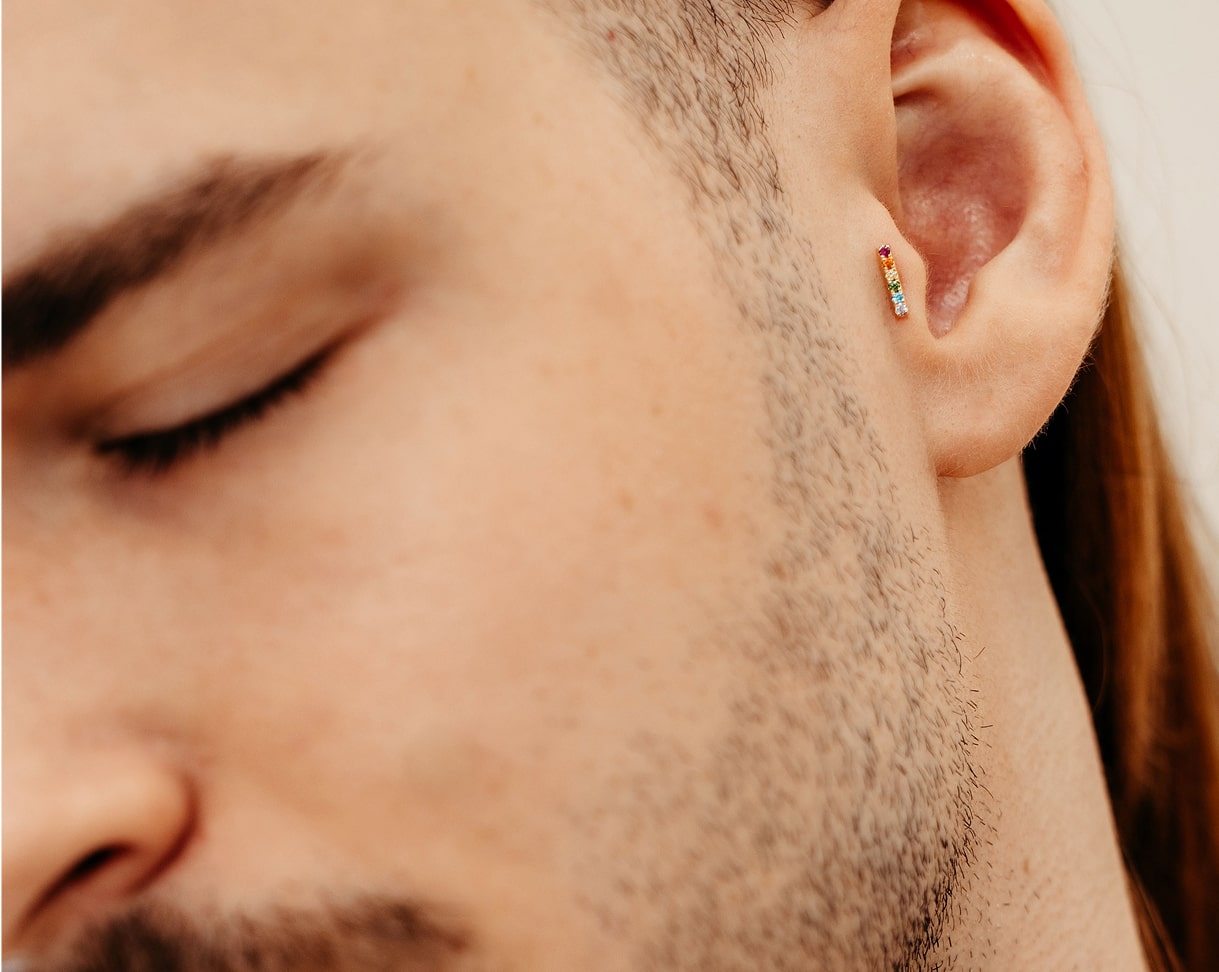
When we celebrate Pride in June, we do so not only out of joy—but also out of protest, remembrance, and pride. Pride Month signifies visibility, self-empowerment, and the celebration of queer identities. It represents a tireless pursuit of equality for all bodies and identities. But what does this actually have to do with piercings?
More than many think.
Modern piercing culture as we know it today—professional, diverse, and artistic—did not emerge in a vacuum. It is deeply rooted in queer, alternative subcultures and evolved from a need for self-determination, distinction, and self-expression.
Pride as a political statement—including through the body
“Pride” signifies pride—the conscious antithesis to the centuries of shame that queer people have had to live with, and still do today. Pride is an active affirmation of individuality and diversity. This very principle is also reflected in piercing: for many people—whether queer, non-binary, trans, or simply non-conformist—body jewelry is a way to make their identity visible. A piercing is not merely a decorative ring in the nose or a stud in the ear; it is often a symbol of individuality, resistance against societal norms, a sense of belonging to a specific community, and self-empowerment over one’s own body.
Stonewall
Colorful parades featuring floats and celebrities, joyful celebrations, workshops, picnics, and parties are among the key elements of LGBTQIA+ Pride Month, celebrated in June in the United States and around the world. Pride commemorates the years-long struggle for civil rights and the ongoing pursuit of equal rights for the lesbian, gay, bisexual, transgender, and queer community, as well as the achievements of queer individuals. But why is Pride Month celebrated in June?
The event that sparked the LGBTQIA rights movement took place in June 1969 at the Stonewall Inn in New York City’s Greenwich Village. In the early hours of June 28, police raided this popular gathering spot for young members of the LGBTQIA community; they arrested staff for selling alcohol without a license, beat many of the patrons, and cleared out the bar. Outside, the crowd watching as patrons were herded into police vehicles grew angry. While witnesses had previously stood by while police harassed members of the community, this time the crowd taunted the officers and pelted them—first with coins, then with bottles and debris—forcing the police to barricade themselves inside the bar and wait for reinforcements. Before long, a riot involving around 400 people was underway.
Although police reinforcements dispersed the crowd, unrest continued to break out in front of the bar over the next five days. These Stonewall riots sparked the LGBTQIA rights movement in the United States.
The march planned for June 28, 1970—the first anniversary of the Stonewall Uprising—was named the Christopher Street Liberation Day March after the street that served as the epicenter of New York City’s LGBTQIA community and the starting point of the march.
The queer roots of modern piercing
When Jim Ward began offering professional piercing services in the 1970s, it was a revolutionary idea—in the truest sense of the word. While piercing had existed in many indigenous cultures for millennia, in the Western world it had long been considered taboo or dismissed as the province of eccentric outliers.
Ward, however, saw this as an opportunity to provide queer people with spaces to discover themselves—beyond heteronormative notions of beauty and the body. His studio, “The Gauntlet,” quickly became a hub for the queer scene in Los Angeles.
It was about more than just aesthetics; it was about belonging, visibility, and pride.
Throughout the 1990s, piercing remained deeply rooted in the queer community. Body modification artists joined the fight for bodily autonomy—the right to do whatever one wished with one’s own body.
Piercing was (and is) an act of self-assertion—especially in a society that often seeks to control or render invisible queer bodies. Sexual expression remains a form of political activism, and queer people are unapologetically “out” wherever they can make a statement.
Piercings as a sign of queer belonging
Long before Pride merchandise could be found in every chain store, queer people used subtle codes and visual signs to recognize one another. Piercings—much like specific styles of dress, tattoos, or symbols—were a form of non-verbal communication. In this sense, piercing was (and is) a queer means of communication—especially during times when it was not safe to be openly queer.
The myth of the “gay ear,” the celebration of femininity, and gender affirmation
Back when being openly gay was far riskier, men often used codes to signal to one another that they were queer. A prime example is the “hanky code” of the 1980s, in which differently colored handkerchiefs worn in specific trouser pockets symbolized queerness and an interest in particular sexual preferences.
Naturally, this was an inherently sexual signaling system, whereas the “gay ear” represented a family-friendly version. From these codes emerged a phrase that few people today recognize as familiar: “Left is cool, and right is gay.” At a time when the piercing community was expanding rapidly and gaining popularity, this statement led many people to realize that a single piercing in the right earlobe signaled one’s identity as a gay man.
However, as the code gained popularity and spread widely, it became too well-known, endangering the safety of those who wore it. Yet the dissemination of the information was inconsistent, and eventually, few could agree on which ear was the “gay ear.”
Classic, bilateral earlobe piercings, however, symbolize the celebration of stereotypical femininity—the process of getting them was comparable to the process of taking hormones. Millions of women—mothers and daughters, sisters and aunts—celebrated the women who had come before them and those who would come after them with this rite of passage.
This celebration was the perfect step for a trans woman to truly celebrate becoming her authentic self. Within the gender binary, simple things like long hair, colorful nails, dresses, and basic earlobe piercings can be a balm for the queer soul. Whether cis or trans, and whether within or outside the binary, piercings provide a positive sense of gender affirmation and gender euphoria for a wide range of people.
Visibility through body modification: A Pride message
In a world that often renders queer people invisible or seeks to force them into rigid boxes, one’s own body becomes a site of resistance. Being visible—through various forms of body modification—is not merely a matter of style, but an expression of attitude. Choosing to get a piercing is a conscious act that challenges societal notions of “normality.”
This form of rebellion has long since evolved: today, piercing is no longer just a fringe phenomenon. It has entered the mainstream—yet its roots, its queer DNA, remain palpable.
Especially during Pride Month, it is worth looking back at the people who paved the way—such as Jim Ward or Fakir Musafar—and at the scenes that shaped piercing as a form of empowerment.
Piercers as Community Builders
In queer contexts, piercing studios have often been more than just places where services are provided. They were—and remain—meeting points, safe spaces, and sites of empowerment. A piercer is not merely someone wielding a needle, but often also a listener, a source of support, and sometimes even a therapist.
To this day, many studios—ours included—view themselves as queer-friendly spaces focused not only on aesthetics but also on bodily autonomy, inclusion, and affirmation. For trans and non-binary individuals in particular, a piercing can help reclaim their bodies—in a way that is both visible and empowering.
A piercing can therefore be far more than just a fashion accessory. It can be a statement:
“This body belongs to me.”
“I decide how I look.”
“I am proud of who I am—and I show it.”
Piercers as Community Builders
Whether or not you have piercings yourself, Pride Month is about more than just outward appearances. It is about the right to define yourself—and to live out that definition visibly. Piercings tell stories—of belonging, courage, and transformation. And they remind us that pride can be not only loud and colorful but also quiet and beneath the skin.
Body jewelry accompanies you on every journey—whether it’s coming out, transitioning, settling on pronouns, or deciding to be something else entirely, beyond all the categories that are considered fixed from the very start for so many queer people.
Pride means: You are good just the way you are.
Your piercings are a reminder of that and a continuation of our colorful history!